

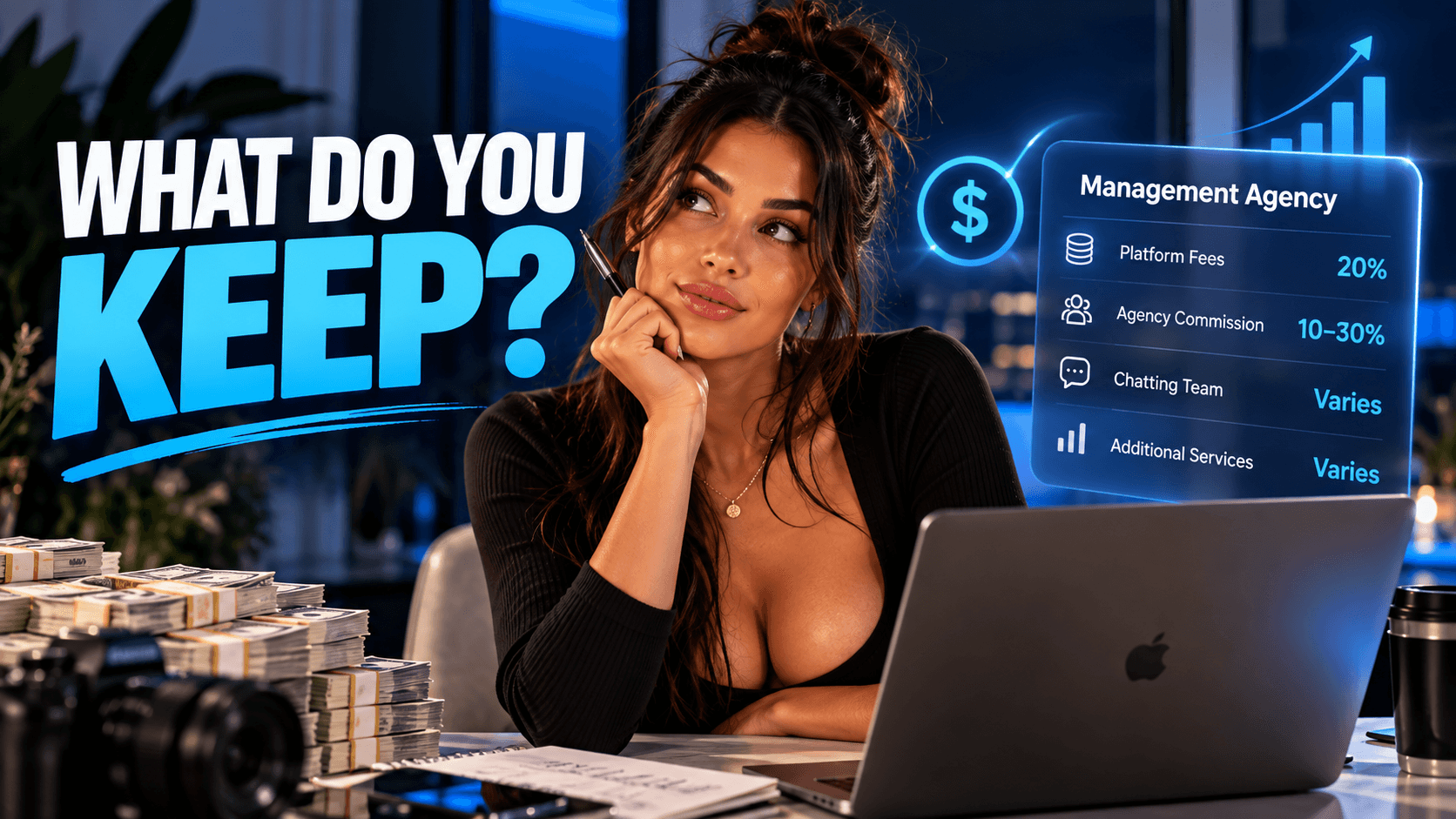
Start with the number you actually need
If you are comparing OnlyFans management offers, you want one thing first: what will you actually keep. Not the headline percentage. Not a screenshot of someone else's revenue. The number that lands in your account after the platform takes its cut, the agency takes its cut and any other costs are paid.
The honest answer is that the total depends on three things: the commission base an agency uses, the scope of work included in that commission, and whether there are extra costs on top. Two agencies can both advertise "30 percent" and mean different things depending on what that 30 percent is calculated from, what tasks it actually covers, and whether anything else gets billed separately. This article gives you a way to compare any offer on the same terms, plus a worked example so the math is not abstract.
This is not a ranked list of "cheapest agencies" or a claim that a lower percentage is automatically the better deal. A lower fee attached to a narrower scope of work can cost you more in your own time than a higher fee attached to genuinely comprehensive support. The goal here is to make sure you are comparing like for like before you decide anything, using your own numbers rather than someone else's marketing.
What published pricing actually says
Commercial pricing guides describe a wide range. Bloom's cost guide and SweetyAgency's commission guide both describe figures broadly in the 20 percent to 50 percent range, while OFAgencies describes a wider 30 percent to 55 percent band for full service work. These are agency and directory descriptions, not a representative pricing study of the whole market, so it is accurate to say published guidance varies across these bands. It is not accurate to call the midpoint an "average" agency fee, because no source here establishes a representative sample.
Specific published offers are more useful than an averaged range. Bloom advertises a chatting only plan at 20 to 40 percent of net and a growth plan at 50 percent of net. Hush Talent advertises full management at 20 percent of gross managed revenue. Notice that the scopes and the bases differ (net versus gross, chatting only versus full management), so the headline numbers are not directly comparable without knowing what they are calculated from.
Historical OnlyFans terms specify a 20 percent platform fee. Current official terms could not be independently verified for this article, so treat 20 percent as a stated assumption in the examples below rather than a guaranteed current figure, and confirm the live platform fee before you finalize any budgeting decision.
A fixed monthly fee, a commission, or a combination of the two all appear in commercial offers. A fixed fee is not by itself evidence of anything good or bad. What matters is what work it buys, when it becomes payable, whether it is refundable, and whether it is disclosed clearly before you commit.
The comparison most creators never do
Here is the part most cost articles skip: agencies calculate commission on different bases, and that difference changes what you keep even when the advertised percentage is identical.
Say your fan revenue for the month is $12,000, and the platform fee is 20 percent, leaving $9,600 before any agency charge.
Illustrative proposal | Fan revenue | Platform fee taken | Agency charge | Your proceeds before other costs and tax |
|---|---|---|---|---|
30% of amount after platform fee | $12,000 | $2,400 | $2,880 | $6,720 |
30% of gross fan revenue | $12,000 | $2,400 | $3,600 | $6,000 |
Fixed monthly fee of $2,000 | $12,000 | $2,400 | $2,000 | $7,600 |
$800 plus 20% after platform fee | $12,000 | $2,400 | $2,720 | $6,880 |
These figures are invented for arithmetic purposes only, not quoted market packages. Notice that at the same headline "30 percent," charging on gross fan revenue instead of the amount after the platform fee costs you an extra $720 in this example. A fixed fee can look cheaper at this revenue level, but it costs the same in a slow month too, which is a different kind of risk.
Why growth alone can be misleading
Here is a break even comparison worth running before you sign anything. Assume you are earning $8,000 solo, with a 20 percent platform fee and no other costs. Your solo proceeds are $6,400.
Now assume an agency charges 40 percent after the platform fee. For your proceeds to also equal $6,400 under that agency, your fan revenue would need to reach about $13,333, which is roughly 66.7 percent more revenue, not merely 40 percent more. That gap surprises a lot of creators who assume the commission percentage and the required revenue increase are the same number.
Take it one step further. At $11,000 in managed fan revenue under the same assumptions, you would retain $5,280. Your gross revenue rose from $8,000 to $11,000, a real increase, yet your retained proceeds actually fell by $1,120 compared to going solo. This is why a rising revenue screenshot does not automatically mean you are better off. You may still value the hours an agency frees up, but that should be a conscious tradeoff you make with real numbers, not an assumption.
This is arithmetic under stated assumptions, not a forecast of what will happen to you. Recalculate it with your own numbers before deciding.
What the fee worksheet should actually ask
Before you sign anything, get clear, written answers to these questions and keep them somewhere you can reference later:
Who is the legal provider, and what services are explicitly included?
What is the fee base, and what is the exact percentage or fixed amount?
What is the billing period, and where does the revenue figure come from?
Does the commission include subscriptions, tips, paid messages, custom content, other platforms, existing subscribers and new subscribers, or only some of these?
What additional costs exist, who approves them, and is there a spending cap?
Is promotion an included labor service, an included media budget, or both?
How are discounts, refunds, chargebacks, currency conversion and late payments treated?
How does a change in scope change the price? If the team stops running marketing but keeps chatting, is the full service fee still due?
A reconcilable invoice should let you reproduce the calculation yourself using your own account data. If you cannot do that, ask why.
What creators actually say about cost
In creator discussions sampled for this piece, a recurring concern is paying a large share of revenue while still doing meaningful promotion and content production personally. Some creators describe an agency that did little beyond occasional messaging. Others describe genuinely valued support. One recent creator questioned their management arrangement despite rising income, attributing part of the growth to their own social media activity rather than the agency's work. That is a useful question about contribution and attribution, not proof that any particular agency contributed nothing, and it points to a real distinction worth asking about directly: does your fee entitle the agency to a cut of revenue you generate independently through your own promotion?
Extra costs that sit outside the headline commission
The commission percentage or fixed fee is rarely the whole story. Ask specifically about paid advertising spend, content production costs such as photographers or editors, software or CRM subscriptions the agency uses to run your account, and any markup added to third party costs before they are passed to you. None of these are automatically unreasonable. The problem is discovering them after you have already agreed to a percentage, with no visibility into how large they might become.
Ask whether there is a spending cap, who approves spend above that cap, and how receipts are supplied so you can verify what was actually spent on your behalf. A transparent agency should be able to show you an itemized breakdown, not just a total.
How to read a revenue screenshot you are shown
Sales conversations in this space often include a screenshot of impressive earnings. A screenshot without context can be entirely real and still be misleading about what it means for you. Before treating any number as evidence of what you might earn, ask for the time period it covers, the starting conditions of that account, whether it shows gross or net revenue, what costs were involved, and what the creator's own workload looked like during that period. A single number without those details tells you very little about your own likely outcome, and no editorial source in this research supports treating one creator's result as a typical or expected result for anyone else.
When paying for management might not make sense yet
It is worth saying plainly: if your fan revenue is small and inconsistent, a percentage based fee on almost nothing may not buy you much, and a fixed fee could be a larger relative burden than it looks. If your main constraint is that you have very little traffic rather than an unmanageable inbox, a management fee focused on chatting will not solve that problem for you. A useful agency conversation should be able to tell you honestly whether your current stage is a good fit for their offer, not just tell you yes.
Common questions about OnlyFans agency cost
Is there a standard commission percentage across the industry? No. Published guides describe ranges, commonly cited between 20 percent and 55 percent depending on scope, but no source in this research establishes an industry average, because there is no representative, published study of actual agency pricing across the market.
Does the fee come before or after the platform's cut? It depends entirely on the agreement. This is one of the single most important things to confirm in writing, since the difference materially changes what you keep, as shown in the comparison table above.
Will the agency take a cut of fans I already had before signing? Ask directly. Some agreements include existing subscribers in the commission base, others do not. This should be explicit, not assumed.
Is a fixed onboarding fee a red flag? Not automatically. The relevant questions are what specific work it buys, whether it is refundable, and whether it was disclosed clearly before you committed. A fixed fee for a defined audit or setup project can be a legitimate, transparent arrangement.
Does a higher fee always mean better service? No source here supports that conclusion. Price should be evaluated against the actual scope of work, not treated as a quality signal by itself. See our guide to red flags before signing with any OnlyFans agency for how to evaluate the service itself.
How does management fee entitlement work if I already had fans before I signed? This depends entirely on how the agreement defines the revenue base, and it is exactly the kind of clause worth reading closely rather than assuming. Our guide to what to read in an OnlyFans management contract walks through how to review compensation clauses line by line before you sign.
If two agencies both say 30 percent, are they the same deal? Not necessarily, as the worked table above shows. The revenue base the percentage applies to, and what is included in the scope for that price, both change what the number actually means for you.
Before you compare another offer
Run every proposal you receive through the same worksheet above: fee base, scope, extras, and a worked calculation using your own revenue numbers. If an agency cannot or will not answer these questions clearly, that tells you something important on its own, regardless of how confident or polished the sales conversation itself sounds. If you want to see exactly what a written scope and fee breakdown from FameU looks like before you decide anything, you can apply and ask for it directly.

